
Main concept
Maintenance Activities
The concept of Maintenance activities refers to a series of everyday life activities that address fundamental human needs through an interpersonal relationship of care[1]. These activities are indispensable for creating, maintaining, and recreating life and well-being. No community can survive in their absence.
Examples of maintenance activities can be cooking and feeding, textile manufacturing and maintenance, provision of cures and attention to the body, emotional support, the rearing and socialisation of children, and the arrangement of spaces of live. Maintenance activities are always necessary, in moments of social calm and stability and in moments of social crisis and existential disorientation, because, even then, they continue to create the conditions necessary to sustain social life.
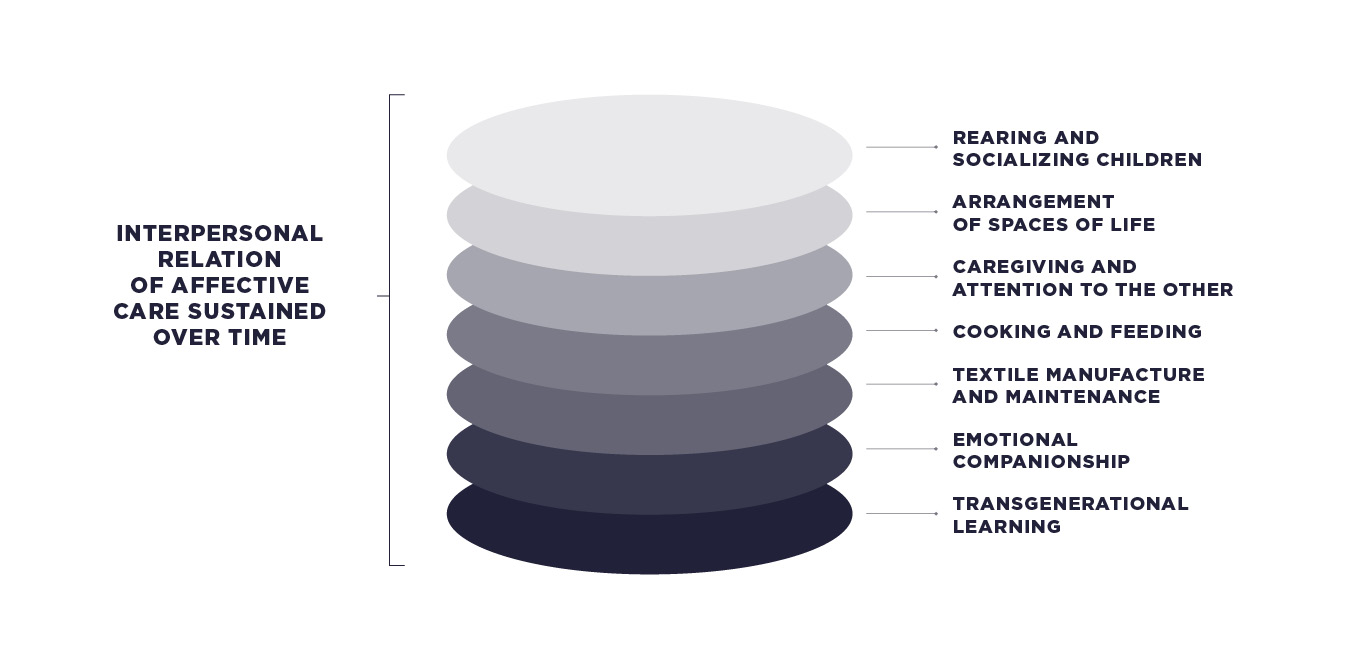
By foregrounding cooperation, interdependence, social bonding, cultural continuity, affective capacity, and care as fundamental to social life, this approach offers different interpretations of the past, because dynamics that usually remain neglected are ‘reinserted’ into history as central. Maintenance activities require and promote identification with the group as a whole and thus self-construction in relational way[2].
The concept of maintenance activities was collectively born within a group of Spanish feminist archaeologists in the 1990s to highlight the structural role of the previous activities and the values, attitudes, capacities, behaviours, and social dynamics required and promoted by them. This approach shares intellectual/political ground with the feminist ethics of care and feminist studies of history and archaeology that have stressed domestic upkeep and household activities as vital labor.
MaGMa investigates how colonial policies targeted maintenance activities and their material culture to change CHamoru Latte lifeways and promote a patriarchal turn, and how these same activities and material culture simultaneously became a site of Indigenous survival and cultural continuity and persistence.
[1] Montón-Subías, Sandra. (2023) Arqueología y cuidados. Representación del pasado, actividades de mantenimiento y prácticas académicas. In: Los bisontes de Altamira los descubrió una mujer : museos, arqueología, patrimonio y género, Fatás-Monforte, Pilar, Díaz-González, Lucía M., and Martínez-Llanos, Asunción (eds.), 39–56. Monografías del Museo Nacional y Centro de Investigación de Altamira 29.
[2] Hernando, A. (2008) Why has history not appreciated maintenance activities? In Montón-Subías, S. and Sánchez Romero, M. (eds.), Engendering Social Dynamics: The Archaeology of Maintenance Activities. Archaeopress, Oxford, pp. 9–15.
Aberigua more
The following is merely a selection, and we apologize for any omissions. If you, dear reader, notice any missing references, please let us know so that we may include them.
- Á. Granell, Carmen. (2024). Escudriñando las materialidades de Tåno’ Låguas yan Gåni entre el 1500 AEC y el 1898 EC: el aprendizaje transgeneracional como dinámica histórica de re-existencia comunitaria. Doctoral Thesis. Universitat Pompeu Fabra.
- Montón-Subías, Sandra. (2019). Gender, missions, and maintenance activities in the early modern globalization: Guam 1668–98. International Journal of Historical Archaeology 23: 404–429.
- Picazo, M. (1997). Hearth and Home: The Timing of Maintenance Activities. In: J. Moore & E. Scott, eds. Invisible People and Processes: Writing Gender and Childhood in European Archaeology. London & New York: Leicester University Press, pp. 59–67.
